There are two main reasons for this:
- The gear ratio between the governor and the ramp plate
- A stripped fuse disc
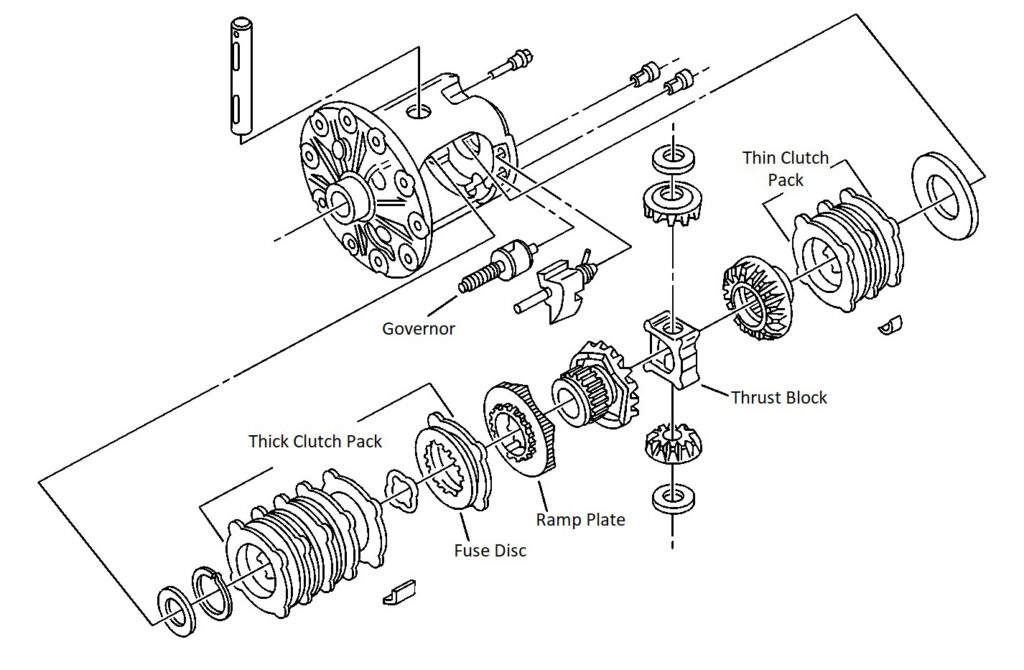
1. If one counts the teeth on the drive gear (the ramp plate) and the driven gear (the governor) you come up with a ratio of approximately 75 to 1. What does the ratio have to do with this? It determines the speed of the rotating governor which directly translates into when the unit will transition from the neutral state to the locked position. Let’s say, for example, that one wheel has all the traction and the other wheel has zero traction. You’re sitting on the side of the road, you decide to stab it to get going into traffic and your free wheel starts to spin uncontrollably. If the speed or latching governor flips out of the way before the flyweights on the governor can latch onto it, the speed of the governor will become excessive and usually the teeth on the governor will ride up on the ramp plate and strip the teeth of one or both parts.
2. Why does the fuse disc strip? As stated in another section, the locking differential design was modified in mid-1986 to include a load-limiting feature to reduce the chance of breaking an axle shaft under abusive driving conditions. We call this special disc the “fuse” disc. The number of tangs on the fuse disc in the left-hand clutch pack was reduced allowing these tangs to shear in the event of a high-torque engagement of the differential locking mechanism.
When the disc shears, the fragments are usually flung outwards and it is not uncommon for one of these to end up between the rotating gear teeth between the governor and the fuse disc. This will immediately destroy one or the other of both of these components.