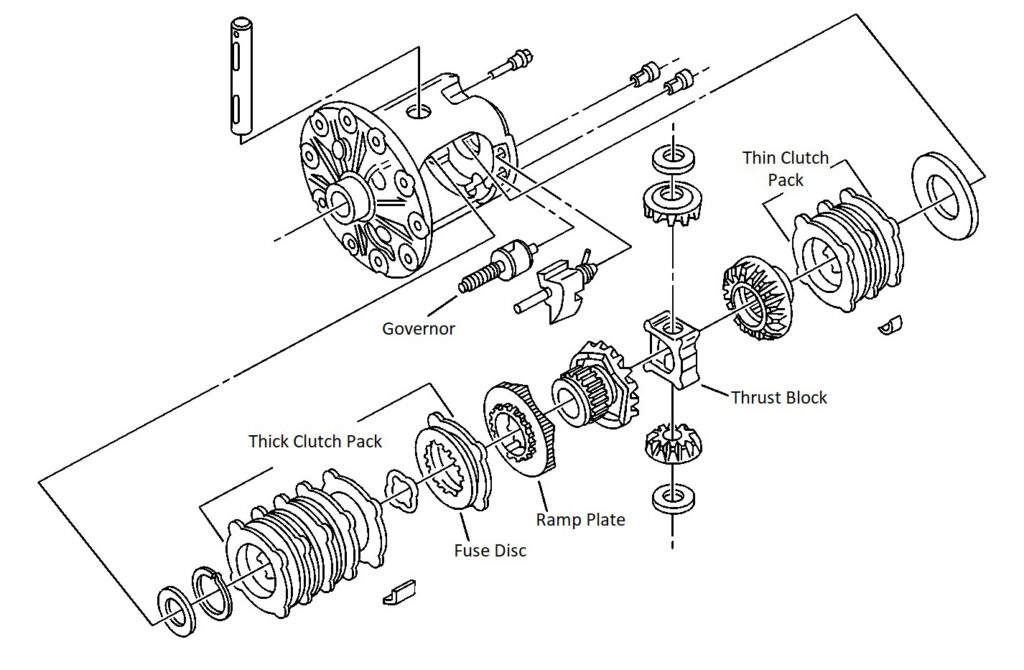
The main reasons for this are:
- Lack of lubrication (lack of service)
- High mileage (worn out clutch packs)
- The shallow angle on the ramp plate / cam faced (LH) side gear
For the most part the LH (or thick) clutch pack only gets used when the differential is locked.
The LH side gear is held in position buy one of the selective shims and this clutch pack floats until needed.
The RH (or thin) clutch pack is used continuously. The back face of the RH side gear compresses this clutch pack
between the case and the gear upon every acceleration event.
As the RH clutch pack wears, the RH side gear moves outboard, opening up the tolerance between this side and the two spider gears. This makes the two gears have heel to toe contact instead of flank or root contact, which greatly increases the pressure on the teeth. The case on the RH side also has a counterbore in it, which helps to center the RH side gear. There is clearance at the bottom of this counterbore. The gear will continue to move outboard as the clutch pack wears until the back side of the gear bottoms out in the counterbore in the case.
The lack of regular fluid changes at suggested intervals causes the fluid to wear out. Worn differential oil thus loses its ability to lubricate properly and accelerates wear on the differential components.
The third factor is the shallow angle on the ramp plate and matching interface of the LH cam faced gear. As the clutches wear out, the gap opens up inside the G80. When a locking event is called for, the distance traveled by ramp plate relative to the LH side gear greatly increases. This leads to a violent transition between the unlocked and locked state, causing even more stresses on the side and spider gears. In extreme cases the unit can even become stuck in the locked position, forcing it to act like a spool – which it was not designed for.
Note: Clutch pack wear accelerates gear tooth failure in ANY clutch type limited slip differential
More on this is coming…